
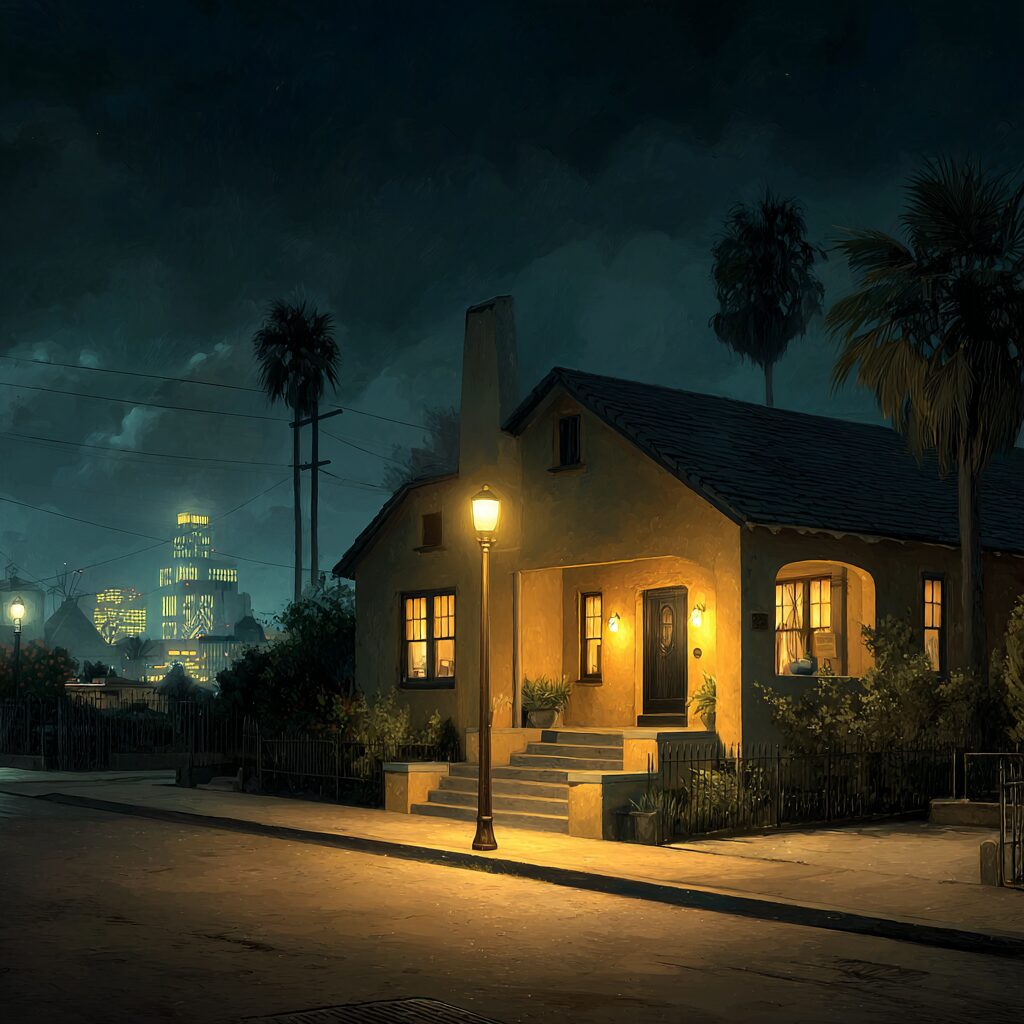
Long before Hollywood turned into red carpets and billion-dollar premieres, it was still a half-invented place — a dusty industry town surrounded by orange groves, where studios were springing up as fast as the rumours that fed them. The early 1920s were glamorous, yes, but also unstable in a way that feels hard to imagine now. People reinvented themselves constantly. Scandals travelled quickly. And reputations could be rewritten overnight.
In that world, film director William Desmond Taylor seemed like one of the steadier figures. Cultured, popular, apparently respectable — not a man you’d expect to be dragged into one of Hollywood’s most infamous mysteries.
But on the morning of 2 February 1922, Taylor was found dead in his bungalow near Los Angeles’s MacArthur Park district.
At first, it didn’t even look like murder. His housekeeper arrived and discovered him lying on the living room floor. For a moment, it was easy to assume the simplest explanation: a collapse, a sudden illness, the quiet sort of death people were used to accepting without too many questions.
Then a doctor examined him properly.
Taylor had been shot in the back.
What should have been a controlled investigation quickly became something else. Before police could properly lock down the scene, the bungalow filled with visitors — actors, neighbours, studio people — all arriving with the same shocked concern… and, quite possibly, their own reasons for wanting the story to go a certain way.
By the time the police took charge, the crime scene was already compromised. Papers had been handled. Bottles removed. Personal items quietly taken away. It’s the kind of thing that makes modern readers wince — but Hollywood in those days wasn’t exactly known for careful procedure or restraint.
And as investigators started to look deeper, it became clear that Taylor’s life was not as straightforward as his polished reputation suggested.
Two actresses were quickly pulled into the spotlight.
The first was Mabel Normand, a genuine star — funny, talented, hugely influential in silent comedy. She was also already bruised by earlier scandal, which made her an easy target when the headlines started circling. Mabel and Taylor were close; some people claimed they were romantically involved, while others insisted they were simply devoted friends.
Either way, one detail made her impossible to ignore: she’d visited Taylor the night before he died.
Taylor walked her to her car, and she drove away. She was, unavoidably, one of the last people known to have seen him alive. The police didn’t seem to treat her as a serious suspect — but the press was less interested in evidence than in drama. The idea of a beloved screen comedienne connected to a murder was irresistible, and the gossip followed her for years. Mabel’s career never fully recovered.
The second actress was Mary Miles Minter, who had been marketed as sweet, wholesome, almost painfully innocent — a girlish contrast to the more sophisticated “vamps” of the era. Taylor had directed her in several films, and behind the scenes she’d developed a fierce romantic attachment to him.
Her letters made that much clear.
And among the items reportedly found in Taylor’s home were an ardent note and a nightgown believed to belong to Mary — exactly the kind of detail that could set a scandal on fire, especially in an industry already watched closely by moral watchdogs.
But Mary wasn’t the only person in that orbit.
Enter: her mother, Charlotte Shelby.
Charlotte was known for being protective — the kind of woman who didn’t simply manage her daughter’s career, but guarded it like a fortress. Rumours spread quickly that she disapproved of Taylor, and not politely. In the weeks and months that followed, suspicion began to drift in her direction.
Partly because people wanted a villain.
But partly because the details were uncomfortable.
Charlotte owned a distinctive pistol, said to be the same calibre as the gun that killed Taylor. Later stories claimed the weapon was thrown into a Louisiana bayou. Her alibi for the night was questioned. A witness who supported her version of events was later rumoured to have received financial help — the kind of quiet assistance that raises eyebrows even decades later.
Still, nothing stuck.
No charges were laid. No trial ever took place. The case remained open, messy, and unsolved — which only made it grow larger over time, the way unfinished stories always do.
Years later, Mary Miles Minter hinted in an unpublished memoir that her mother might have been involved. And decades after the murder, director King Vidor privately looked into the case himself and became convinced — at least in his own mind — that Charlotte Shelby had pulled the trigger.
By then it hardly mattered. Witnesses had died. Memories blurred. Records were incomplete. Any truth that might once have been clean enough to hold up in court had slipped out of reach.
What’s striking is that Taylor’s murder happened at exactly the wrong moment for Hollywood. The industry was already under pressure from reformers and church groups, who pointed to drunken parties, broken marriages, and sudden deaths as proof that films — and the people who made them — were a corrupting force.
An unsolved murder in the home of a respected director became one more headline that seemed to confirm their worst suspicions.
Not long after, studio bosses began cleaning up their public image. A new set of rules emerged, later known as the Hays Code, restricting what could be shown on screen and trying to convince audiences that Hollywood was, in private life, far more respectable than its gossip columns suggested.
But the Taylor case has never fit neatly into anything.
The bungalow is long gone now, and the silent era feels like another world — soft-focus, sepia-tinted, half-mythologised. Yet the story remains: a respected man with secrets, a circle of ambitious and frightened people, and a city learning in real time how to protect itself.
And like the best mysteries, it doesn’t give us answers.
It leaves us with the lingering sense that whatever happened that night was witnessed — briefly — and then quietly swallowed by the machine that was Hollywood.